You May Peek at Your Data

Earlier this month, I gave the Horizon Lecture at the Australian Statistical Conference 2025 in Perth. I am grateful to the Statistical Society of Australia for providing me with this opportunity.

My slides are available online.

In my lecture, I introduced the audience to sequential analysis, a branch of statistics in which we can analyse and draw conclusions ‘as the data come in’ and as often as we like, rather than only a single time once we have collected all of the data. Amongst other benefits, this allows us to be resilient to the problems of ‘peeking’, ‘p-hacking’ and other forms of undisclosed or inadvertent multiple comparisons.

Sequential analysis goes back as far as the 1940s, with the development of the sequential probability ratio test (SPRT) by Abraham Wald. While that was a landmark advance in statistical methodology, it was not widely known amongst the audience at the conference (based on a show of hands at my lecture). For whatever reason, such methods are rarely taught. In my 4 years of undergraduate education, I only had a single lecture on the topic!

Recently there has been substantial new research into statistical methods that are ‘anytime-valid’, especially to give researchers ‘safer’ statistical tools that allow optional stopping or optional continuation (deciding to stop a study early, or collect more data than originally planned, based on looking at the data so far), without compromising the desired significance or confidence levels.

I summarised some of these developments in my lecture, and then described how we used them to design an award-winning method for auditing preferential elections.
Impact award from OPTIMA

Last month my colleagues and I received the Ariel Liebman Memorial Impact Award for 2025. This recognises research that has significantly contributed to optimisation technologies and embodies innovation, excellence, collaboration and real-world impact.

Congratulations to the whole team: Alexander Ek, Michelle Blom, Peter Stuckey, Philip Stark and myself.

We received the award for our work developing the AWAIRE method for auditing preferential elections. This is described in the following three papers:

  • The original AWAIRE paper, where we introduced our new method that uses adaptively weighted averages of test supermartingales. This won a best paper award at a conference in 2023.
  • The ‘weighting schemes’ paper, a follow-up investigation of many different weighting algorithms that could be used in the AWAIRE method.
  • The ‘incremental AWAIRE’ paper, where we developed a new, more practical implementation of AWAIRE, using techniques from optimisation to substantially improve computational efficiency and allow us to tackle much larger elections.

Our open-source implementation of AWAIRE is freely available online. We are currently in the process of integrating it into the SHANGRLA software package.

I have greatly enjoyed working on this project, especially the opportunity to do something truly interdisciplinary. Our method combines the latest ideas in the fields of statistics and optimisation, something none of us could do alone!

The award was given by OPTIMA, a research and training centre in optimisation technologies and applications. It is a joint initiative between the University of Melbourne and Monash University, with funding from the Australian Research Council.

Best paper award at E-Vote-ID 2023

As the year draws to a close, I was reflecting back on some of the highlights.

I went skydiving, discovered foraging, did some fun escape rooms, and started a new job at Monash University. Also some notable recent successes: a Service Award from the Statistical Society of Australia, and a paper in Nature (with long-time colleague Stephen Leslie, our former PhD student Georgia Tsambos, and several other colleagues).

However, I’d like to highlight one piece of work in particular.

With our ARC grant in action, last year we brought Alexander Ek into our team and this year developed a new auditing method for preferential elections.

A challenge with such elections is the very large number of ways that voters can cast their vote. With 10 candidates there are about 3.5 million possible ways to rank them in order. With 12 candidates this goes up to 479 million, and it rapidly increases as you add more candidates. The number of ways that the election count could evolve (as a sequence of candidate eliminations) is correspondingly very large.

This makes it tricky to do any statistical inference from a sample of the ballots. The best existing method relied on having access to a digitised version of all of the ballots in the election (for example, if they were all digitally scanned) to pick an optimal set of hypotheses to test. Our new method, which we have called AWAIRE, uses a special technique to ‘learn’ a such a set from the sample alone. That means we do not require a digitised copy of the ballots, allowing our method to be used for more elections. Moreover, the statistical ‘price’ we need to pay for this generality (for doing the learning) is relatively small.

We presented our method in October at the E-Vote-ID 2023 conference and received the Best Paper Award in the technical track.

Statisticians jump out of a plane

Last weekend, I joined four other statisticians in a skydive. We were treated to marvellous views of Melbourne as we floated down to the ground early on Saturday morning.

Some of our colleagues were disturbed to hear of our plans, and even thought it reckless to be putting so much local statistical expertise at risk! That got me thinking, how dangerous was it? Of course, I waited until after our skydive to look this up…

A convenient measure of this type of risk is a micromort: representing a one-in-a-million chance of dying due to a given event or activity. We can look back at historical data to get a rough assessment for any activity. For skydiving, it is about 8 micromorts. This is averaged across a large number of skydives. In our case, since we were jumping in tandem with very experienced instructors, I would guess our risk would be lower than this average.

How does this compare to other, more familiar, activities?

Running a marathon or doing a scuba dive are of similar risk to a skydive. As is riding a motorbike for 80 km (Melbourne to Geelong), driving a car for 3000 km (Adelaide to Darwin) or flying 13,000 km (Melbourne to Seattle). I don’t know if that would reassure my risk-averse colleagues, or terrify them to stay at home.

Some much riskier activities are BASE jumping (430 micromorts) and climbing Mount Everest (40,000 micromorts). I’m definitely staying away from these!

For more on this topic, I recommend Hassan Vally’s 2017 article in The Conversation on how deadly our daily activities are.


A version of this article was published in the 16 March 2023 edition of SSA’s weekly bulletin.

In for the count

As we close out another pandemic-afflicted year, I look forward to better times ahead. Like other parents with young children, I had to hit ‘pause’ on many things in 2021. However, I am glad to have received a last-minute Christmas present, in the form of a Discovery Project grant!

For the non-academics amongst you, this is funding from the Australian Government (via the Australian Research Council) for research projects. These are very competitive and given out only once per year. The success rate this year was 19%. See here for details and stats about all funded projects.

What’s our project?

Together with my colleagues Michelle Blom, Philip Stark and Ron Rivest, we will develop methods for auditing election outcomes. Our project is called In for the count: Maximising trust and reliability in Australian elections.

The idea is to do something much quicker and cheaper than a recount, by randomly sampling the ballot papers and statistical inferring the result. Methods to do this are already available for simple election systems such as first-past-the-post. However, our preferential elections in Australia are more complex and still lack rigorous audit methods.

Why do we need to audit?

Scrutineering is a key ingredient in the success of Australian elections. We have an excellent track record in this.

Unfortunately, our Senate election is being increasingly automated, in a way that has not allowed for proper scrutineering. Instead of the ballot papers being counted fully by hand, they are scanned and counted digitally, using computer systems that are not open to scrutiny in the same way.

Do we do any auditing already?

At present in Australia, audits of this type are not conducted. However, our research funding couldn’t have been more timely. Earlier this month, the Australian Parliament recognised the need for more scrutiny and passed a bill that requires various process for verifying the security and accuracy of the Senate election. This will include a random sample of the paper ballots, to compare against their digital version.

The requirements aren’t fully spelt out in the bill, and I won’t delve into the details, but suffice to say that the key step of sampling the paper ballots is a common feature in both the bill and the methods we envision developing.

These requirements will kick in at the next federal election, which is now only months away. It’s exciting that our research topic will be of such immediate relevance.

Where is that Lego brick?

Last year, my kids and I enjoyed assembling the Lego Gingerbread House. It was a dream Christmas present.

After carefully packing it away, we unveiled it again this year as a fun Christmas activity.

With almost 1500 bricks, some of them proved quite elusive to find! We poured them all out on a tray and combed through them thoroughly. Many. Times. Over.

If this was a random box of Lego bricks, at this point I would give up, confidently declaring that our desired bricks were absent. But I persisted. I knew those bricks were here somewhere.

A few minutes later…success!

My Bayesian self congratulated me on not letting the wealth of data overwhelm my highly accurate informative prior.

How to rate restaurants

I am a frequent user of Zomato, and its predecessor Urbanspoon. I use it to find good places to eat and I also give back by providing my own ratings.

In the beginning, I would sometimes spend a while mulling over what rating to give. My dining experience is often multifaceted and I am forced to distil it to a single categorical rating, or even just a binary rating in Urbanspoon’s case! What if the food was delicious but the service terrible? The venue well designed but very noisy due to construction across the road? If I enjoyed my meal but thought it was overpriced?

I certainly can’t convey all of that nuance with a single rating. As a result, if I feel like I need to say something specific I will actually write a short review. However, I also want to make my numerical rating as meaningful as possible. What’s the best approach?

Would you recommend it?

I decided to think about how my ratings would be used by others. When I look up a restaurant, I am interested in one thing: should I dine there?

To rate the places I visit I answer that question directly. Namely, would I recommend it to a friend?

Back when Urbanspoon was in existence, that was it. The answer would be a straight ‘yes’ or ‘no’, and I was done. Easy, straightforward.

I was surprised how much easier my job became simply by framing a clear, actionable question. Urbanspoon was already as easy as you can get, allowing only a binary rating. Nevertheless, without the clarity of a question I was sometime still unsure of how to rate some places.

Beyond binary ratings

When Urbanspoon got taken over by Zomato, I was sad to see the elegantly simple binary ratings replaced by a messier 5-star system. I was once again in limbo. I needed a framework for giving clear, consistent, meaningful ratings on a 5-point scale. Here’s what I came up with.

I ask myself the following questions:

  1. Was I generally happy with the food and service?
  2. Would I recommend this place to a friend?
  3. Would I come back again?

Any restaurant that got a ‘yes’ for the first question starts with a rating of 3/5. Each extra ‘yes’ for the next two questions gets an additional 1/5. If the answer to the first question is ‘no’ (in which case, all of them will be ‘no’), then I will rate it 2/5, or bump it down to 1/5 if the experience was so terrible than I think the place should be forcibly shut down.

With this framework in place, I find rating restaurants straightforward once again.

Perhaps Zomato should implement a system of questions like this, rather than letting people give arbitrary numbers from 1 to 5?

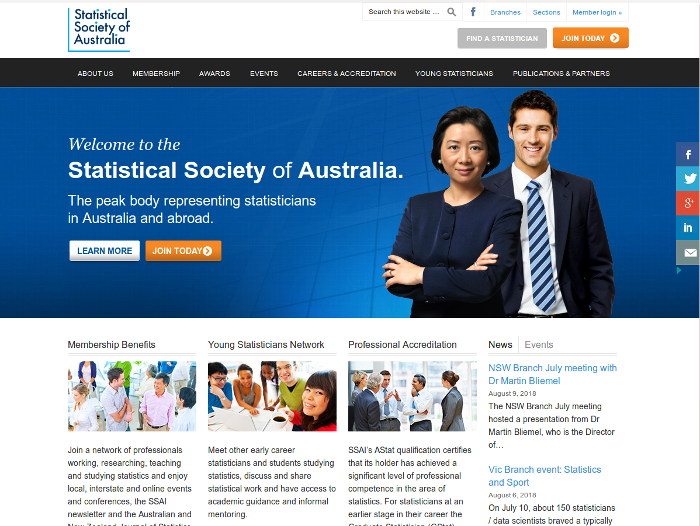
New website for the Statistical Society of Australia

Following in the footsteps from last year, the Statistical Society of Australia (SSA) continued rebranding by launching a new website on 4 Dec 2018.

I have been actively leading the committee that commissioned and implemented the new website.

The website was designed by Converge Design and is hosted using the Wild Apricot association management system.

More than a website

Moving to a new website ended up taking us more than a year. A website is a central point of information and interacts with many other systems. Finding an appropriate platform to use that suited our requirements and budget was a complex task.

Our initial motivation was to update the look and feel of the website. In doing so, we also made substantial changes ‘under the hood’. We now have a completely integrated system for managing our membership database, events calendar, email announcements, billing and, of course, our website. This should make many of our administrative tasks much easier going forward.

Old website

We say goodbye to our old website…

Congratulations Alison Harcourt

This article was first published in the SSA November 2018 eNews under the title “Well-deserved recognition for Alison Harcourt’s tireless dedication to mathematics and statistics”, written by Damjan Vukcevic & Karen Lamb.

In the last newsletter, SSA reported on the ABC 7.30 program which featured SSA member, Alison Harcourt, and her inspirational career in mathematics (see also the accompanying story on ABC Online).

We are delighted to hear that since then Alison has been named Victoria’s 2019 Senior Australian of the Year. This award recognises Australians in Victoria aged at least 65 years who are still actively contributing and achieving in their work; this is certainly true of Alison. To this day she continues to train new generations of mathematicians and statisticians and has been a mentor to many great statisticians who have long-since retired!

The accolades continued for Alison who was also awarded an honorary Doctor of Science by the University of Melbourne. In addition to her dedication to training and mentoring, these awards recognise Alison’s remarkable achievements. The most visible ones include her seminal paper on the “branch and bound” method, her contributions to quantifying the extent of poverty in Australia and her work that led to the introduction of the “double randomisation” method in allocating positions on ballot papers (still in use today). Given that Alison was working at a time when there was much less support for women, this sort of recognition is well overdue.

Finally, we must mention that Alison was the founding secretary of the Victorian Branch of SSA, back in 1964. It is great to see her still attending our branch meetings regularly and supporting the society.

The Australian of the Year Awards are awarded to “leading citizens who are role models for us all”. Alison is definitely one of those. Congratulations Alison!

Your first R package

Today I gave a short talk about writing R packages at the Research Bazaar 2018 (University of Melbourne). I’ve made my slides available online.

The talk is aimed at R beginners. I assume you already know how to write basic functions and want to take the next step and learn to put these together into packages.

If you are a more advanced R user, I recommend starting with my much longer talk about R packages that I presented at the Melbourne R user group in 2016.